
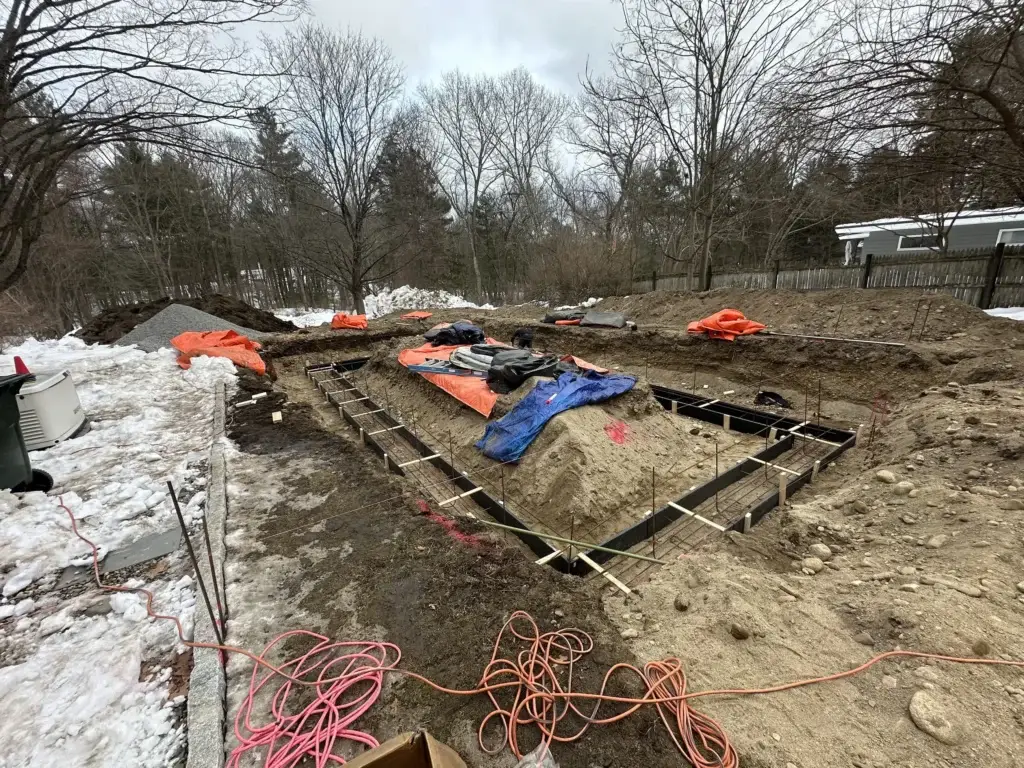
Winter construction in New England is absolutely possible with the right preparation. Our team keeps sites active through the cold months on additions, ADUs and custom homes by protecting concrete, managing moisture and getting the structure closed in quickly. Daily photo updates document every step, ensuring transparency and quality regardless of the season.
Key Takeaways
- Winter construction in New England shifts the priority to getting the shell closed in so interior work begins under controlled conditions.
- Cold weather concrete placement requires heated enclosures, insulated blankets, and mix designs formulated for low temperatures.
- Temporary heat runs off a dedicated electrical service installed early in the build and becomes a real cost in the budget.
- Daily job-site photo updates matter more during winter because homeowners visit less when roads are icy or daylight is short.
Can you build a house in winter in New England?
Yes, building a house through a New England winter is entirely possible. Preparation matters more than temperature. Snow, frozen ground, shorter days, and shifting temperatures all affect how a job site operates, which is why many homeowners assume building has to stop once cold weather arrives.
That assumption costs homeowners months of schedule time. Winter construction in Massachusetts works best when the right conditions are in place. Site access, design readiness, and the type of work being done all influence how a project should be scheduled.
What actually changes during winter construction?
Winter changes how construction works in Massachusetts. The season shifts how materials are handled, how quickly a structure gets enclosed, and how moisture is managed throughout the build. Those factors have a much bigger impact on progress and quality than the season itself.
We serve homeowners across the North Shore of Massachusetts and the Merrimack Valley. Our team plans winter work around enclosure timing and material protection. Foundation method is a design choice, not a winter workaround: depending on the project, we build conventional poured foundations or ICF construction, and either can go in during the cold months with the right protection.
Is winter a bad time to start a project?
Not necessarily. Many homeowners assume building has to stop in cold weather, but preparation matters more than temperature. A well-sequenced winter build keeps framing, mechanical rough-in, and interior finishes on schedule. The key is having a documented plan before the first snowfall.
Can you pour concrete in winter?
Yes, you can pour concrete in winter. Cold weather concrete placement succeeds across New England every season when the right protections are in place. The risk is not the cold itself. The risk is concrete that freezes before it cures, losing strength it never regains.
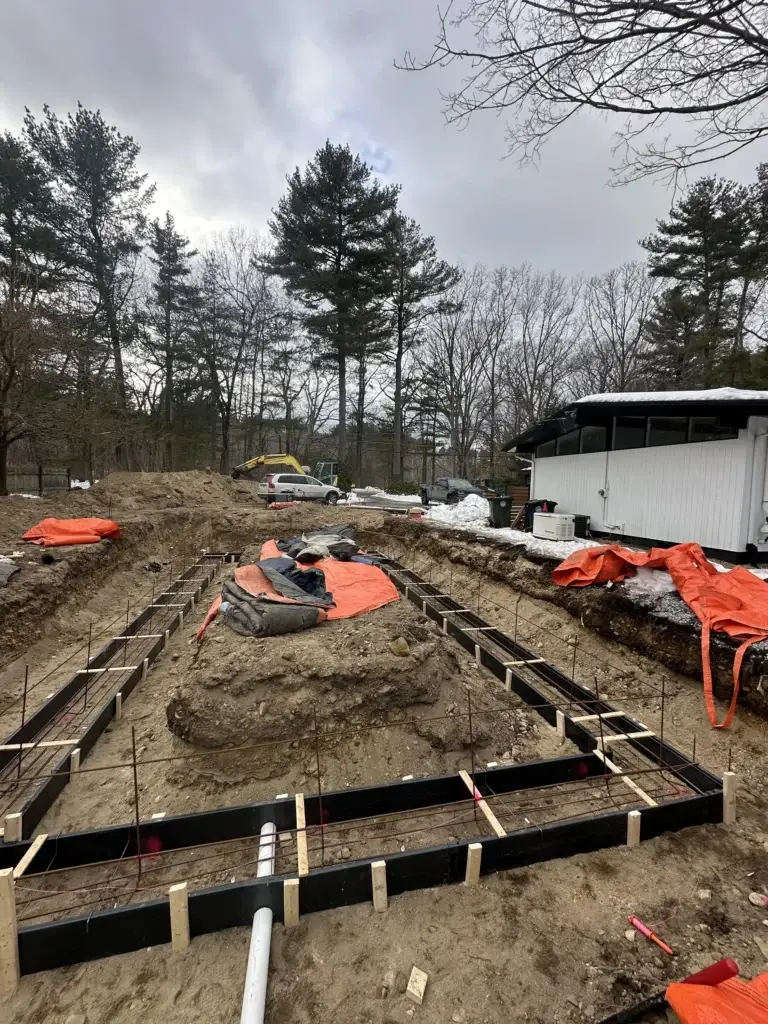
Pouring foundation in winter requires heated enclosures, insulated blankets, and mix designs formulated for low temperatures. We protect fresh concrete from freezing for the critical early curing window. Site access and design readiness matter more than the thermometer reading. A well-prepared winter pour produces a foundation as strong as one placed in July.
How does the frost line affect winter foundations?
New England’s frost line foundation requirement means footings must sit below the depth where ground freezes. That depth varies across the region, and excavating to it in frozen ground takes more time and equipment. But the requirement itself does not change with the season. A foundation placed above the frost line heaves and cracks regardless of when it was poured.
What does winter foundation work look like in practice?
A detached ADU we built in Andover started with winter footings and went on to a finished shell. The homeowner’s ground-floor office and second-floor in-law suite were both planned before we broke ground, so the foundation work followed a settled design instead of changing partway through. Cold weather adds steps, not stoppages. With the design set early and the site documented every day, winter is a working season for us.
What happens on site during winter construction?
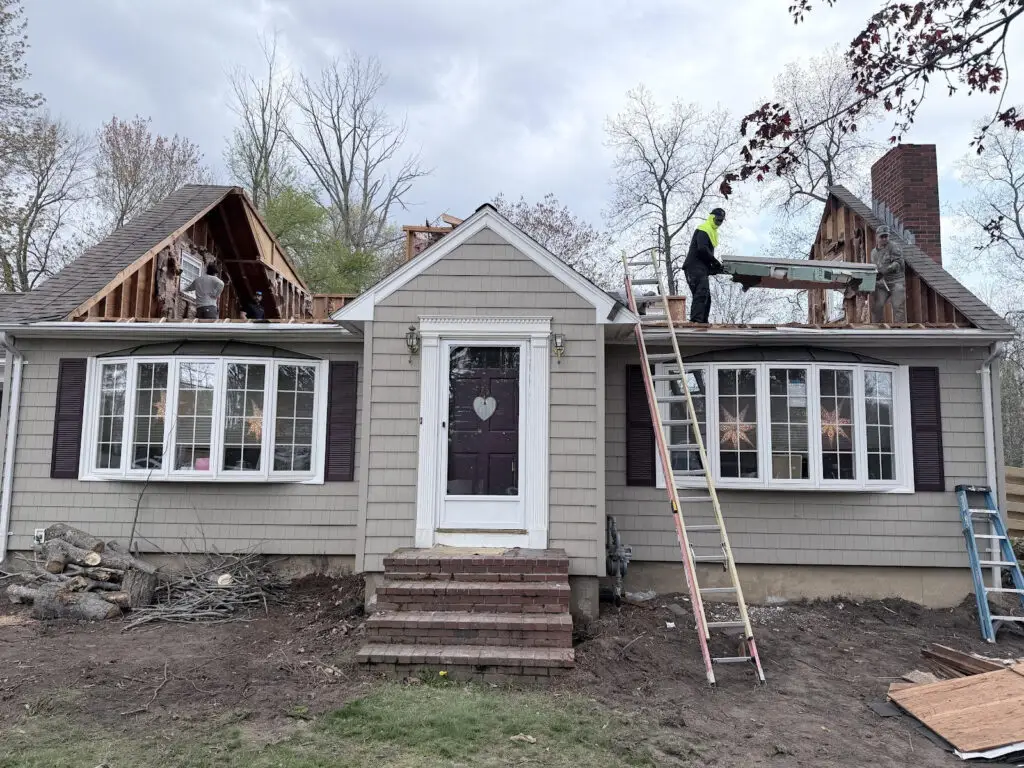
Winter construction in New England shifts the priority to one goal: getting the shell closed in. Framing and pouring foundation in winter both happen, but the real race is reaching dry-in so interior work can begin under controlled conditions. Once the roof and sheathing are on, the site transforms. Temporary heat takes over, and the crew moves inside.
Cold weather concrete placement requires a few extra steps. We protect fresh pours with insulated blankets and monitor cure temperatures. The work does not stop. It just follows a different sequence.
How does temporary heat work on a winter job site?
Temporary heat runs off a dedicated electrical service installed early in the build. An electrician wires the setup, and the heating unit itself becomes a line item in the budget. This is not an afterthought. It is a real cost that belongs in the estimate from day one.
We built an above-garage addition in Newburyport through the coldest months of the year. Rick White, our founder, set up temporary heat off a temporary electrical service so the trades could keep working inside in comfort. When drywall and plaster went up, the permanent heating system stayed off and covered, so construction dust never got into it. As Rick put it, the setup is not complicated, but it is a real cost: an electrician has to wire it and you need the unit. That is why we put it in the estimate from the start.
Can interior work continue once the shell is enclosed?
Yes. Interior work under temporary heat proceeds without weather delays. Drywall, trim, painting, and flooring all happen inside a conditioned space. The outside temperature stops mattering for most trades.
Daily job-site photo updates matter more during winter. You are less likely to visit when roads are icy or daylight is short. Our photos show exactly what happened that day, from the day’s progress to the trim going up. You stay informed without standing in the cold.
What does winter add to the schedule and budget?
Winter construction in New England adds some cost for heat and protection, plus weather days in the schedule. A winter build in New England does not double your budget or stall for months. The real impact is modest and manageable when the builder plans for it from day one.
We budget for temporary heat, concrete blankets, and enclosure materials before the first frost. These line items protect the work and keep crews productive. Weather days do happen. A nor’easter shuts down the site for a day or two, and that lost time gets built into the schedule from the start. What surprises homeowners is how much forward progress happens during the cold months.
How do you control winter costs?
A documented scope and transparent pricing help manage winter-related costs. We provide detailed scopes with clear pricing upfront. Any changes during construction go through a documented change-order process. You approve costs in writing before we proceed. No surprises show up on the final invoice.
Does winter slow down the whole project?
Commercial-grade project management keeps winter builds on schedule. We bring professional project management from large-scale commercial builds to your home. Clear schedules, documented milestones, and accountable execution keep every phase moving. Our founder, Rick White, spent his career running large commercial builds, and we apply that same discipline to additions and custom homes.
Winter is also when design, surveys, and permitting happen for a spring start. While the ground is frozen, our team advances everything that does not require excavation. By the time the frost leaves, your project is fully permitted and ready to break ground. Our design-build process keeps design, permitting and construction with one team, so nothing waits on a handoff. That sequencing alone often saves more calendar time than winter weather adds. For a full breakdown of what drives total project cost, see our custom home cost guide.
Is winter the best time to build a house?
The best time to build a house depends on your priorities, not the calendar. Winter offers distinct advantages for New England homeowners who want their home ready by spring, provided the right preparation is in place.
Winter construction in New England succeeds when three conditions align. Site access must remain clear. Design documents need to be fully approved before ground breaks. And the type of work being done must match the season’s realities. Heavy snowfalls, freezing temperatures, and shorter days define New England winters. Construction does not necessarily halt during these months, but it requires careful planning and adjustments to material handling and crew scheduling.
Seasoned professionals know how to protect against the elements. They follow a timeline that carries work through the cold months so the home is finished for springtime. That timeline advantage disappears when homeowners wait until April to start. Spring ground-breaking often means moving in during late fall or early winter instead.
What makes winter construction work in New England?
The right builder makes the difference. Teams with cold-weather experience manage frozen ground, protect materials from moisture, and sequence work so the structure gets enclosed quickly. Without that experience, delays compound and costs climb.
Does winter construction affect long-term quality?
Not when the builder controls the process. We enclose structures fast and monitor conditions daily. After completion, our Bradford Home Services team provides ongoing maintenance and support, so your home stays protected through every season that follows.
FAQ
Can you build a house in winter in New England?
Yes, building a house through a New England winter is entirely possible with the right preparation. Preparation matters more than temperature.
What actually changes during winter construction?
Winter shifts how materials are handled, how quickly a structure gets enclosed, and how moisture is managed. The season changes site operations, not the ability to build.
Can you pour concrete in winter?
Yes, concrete placement succeeds in winter with heated enclosures, insulated blankets, and low-temperature mix designs. The risk is concrete freezing before it cures.
Conclusion
Winter construction in New England works when the builder plans for it. The shell gets enclosed fast, temporary heat keeps interior work moving, and the schedule accounts for weather days. A documented scope and transparent pricing prevent surprises. The question is not whether winter allows building. It is whether your builder has the discipline to manage it.