
ICF Foundations for ADUs and Home Additions in New England
By Bradford Construction Management Editorial Team · Updated 2026-07-10
ICF foundations for ADUs and home additions in New England deliver a continuously insulated, airtight shell built to withstand harsh regional weather. Bradford Construction Management, based in Plaistow, NH, brings over 10 years of ICF building experience to foundations, additions. ADUs, with transparent itemized pricing and daily photo updates throughout construction.
ICF foundations give New England ADUs. home additions a continuously insulated, airtight shell built to withstand the region’s harsh winters. Bradford Construction Management delivers ICF foundation work across Massachusetts and southern New Hampshire with transparent itemized pricing, one accountable team. Daily timestamped photo updates throughout every project.
Key ICF Foundation Benefits and Considerations
- ICF foundations create a continuously insulated, airtight shell that withstands harsh New England weather conditions.
- Bradford Construction Management in Plaistow, NH builds ICF foundations for ADUs and home additions.
- Frost-protected shallow foundations (FPSF) reduce costs, moisture buildup, and energy loss compared to conventional systems.
- A single accountable team handles ICF projects from foundation work through completion.
Why Do New England Homes Need ICF Foundations?
Cold climate ICF foundations solve a problem that conventional construction has never fully answered: how to keep a New England home structurally sound, energy-efficient, and moisture-resistant through freeze-thaw cycles that punish ordinary concrete year after year. Homes without a continuously insulated, airtight shell lose significant energy through foundation walls — a loss that compounds across every heating season.
New England’s climate demands more than a standard frost wall delivers. Despite decades of available alternatives, few builders in the region historically adopted advanced foundation systems over the traditional 4-foot frost wall approach. That gap left homeowners with foundations that underperform on insulation, air sealing, and long-term durability.
Bradford Construction Management builds with insulated concrete forms for custom homes, additions, and ADUs across the North Shore of Massachusetts and Southern NH — applying the same commercial-grade discipline to every foundation pour.
What are the pros and cons of ICF foundations in New England?
Understanding icf foundation pros and cons helps homeowners make an informed decision. The core advantages include a continuously insulated shell, superior airtightness, and structural resilience against harsh weather. The primary trade-off is upfront cost, which runs higher than a standard poured concrete wall.
How does ICF compare to poured concrete for a home addition or ADU?
The icf vs poured concrete foundation distinction matters most in cold climates. An icf foundation for home addition or an icf foundation for adu new england delivers built-in insulation that poured concrete alone cannot match. ICF foundation energy savings accumulate over time, offsetting the higher initial investment across multiple heating seasons.
How Does ICF Compare to Poured Concrete Foundations?
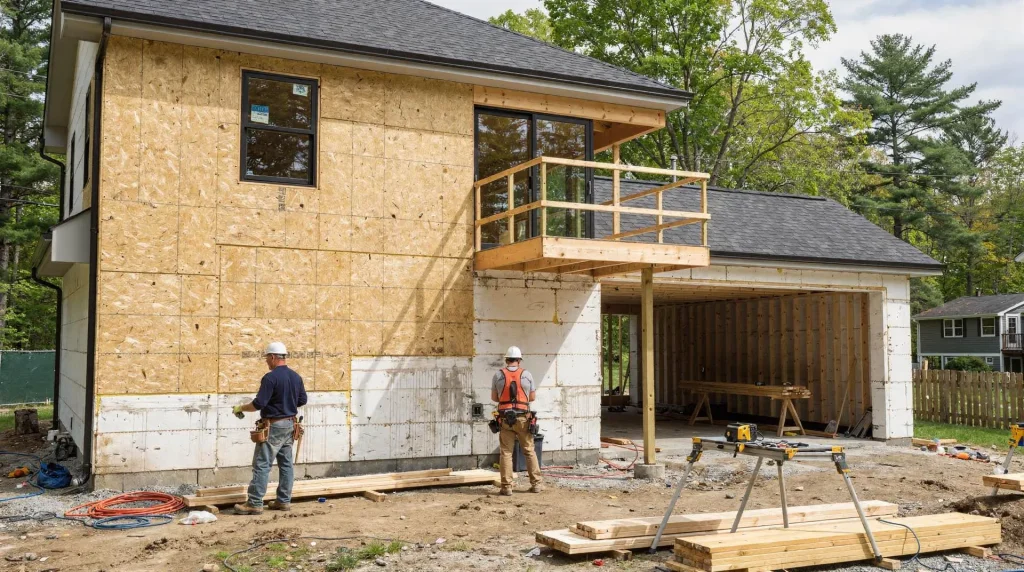
ICF vs poured concrete foundation performance differs significantly across strength, energy efficiency, and long-term durability. Choosing the wrong foundation type locks homeowners into an irreversible decision — and in New England’s freeze-thaw climate, that mistake compounds every winter.
Insulated concrete forms (ICF) deliver superior strength, insulation, and durability compared to conventional poured concrete. ICF homes test at roughly 6 times stronger and approximately 60% more energy efficient than standard construction — numbers that matter when a nor’easter is driving wind and moisture through a foundation wall.
| Factor | ICF Foundation | Poured Concrete |
|---|---|---|
| Structural strength | ~6x standard construction | Baseline |
| Energy efficiency | ~60% improvement | Baseline |
| Insulation | Continuous, built-in | Requires separate insulation layer |
| Cold-climate performance | Excellent | Moderate without added insulation |
Is ICF a Smart Choice for a Cold Climate Foundation?
A cold climate icf foundation performs exceptionally well in New England because the foam forms create a continuously insulated, airtight shell. Poured concrete alone conducts cold readily, requiring additional insulation steps that add cost and complexity to any project.
How Do ICF Pros and Cons Apply to Additions and ADUs?
Understanding icf foundation pros and cons is especially critical for accessory dwelling units and additions. Foundation selection ranks among the first and most consequential decisions on any project. An icf foundation for adu new england build or an icf foundation for home addition delivers measurable icf foundation energy savings over the structure’s lifetime. Upfront costs run higher. North Shore and Merrimack Valley custom builds incorporating ICF construction extend toward the upper end of the regional cost range. Bradford Construction Management, a Plaistow, NH-based design-build firm serving New England, guides clients through this trade-off with transparent, itemized pricing from the first consultation.
What Are the Real Pros and Cons of ICF Foundations?
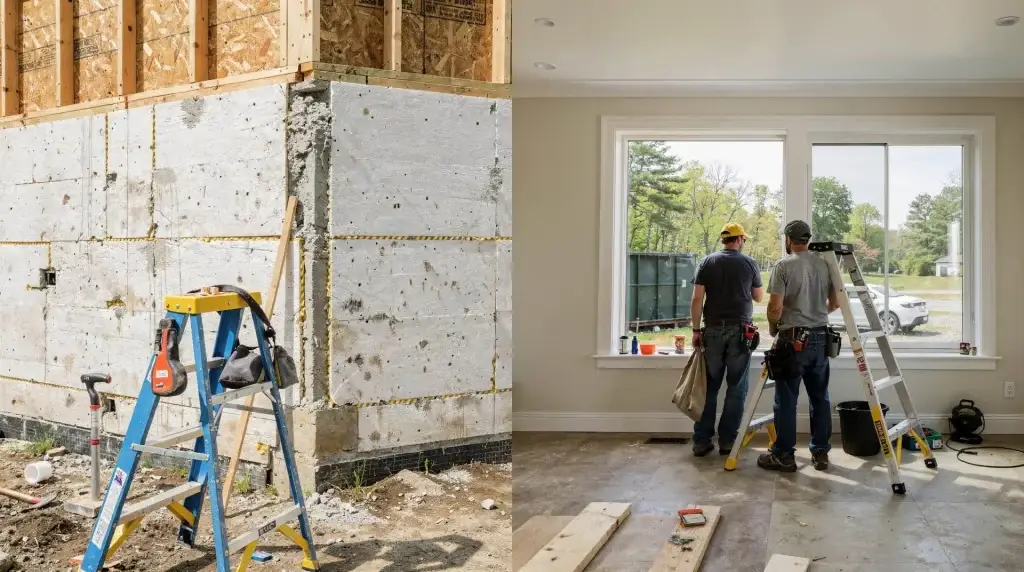
ICF foundation pros and cons break down clearly: superior thermal performance and structural strength on one side, specialized contractor requirements and higher upfront complexity on the other. Homeowners who skip this evaluation risk locking in one of the most expensive and irreversible decisions on their entire project without the knowledge to make it correctly.
How Does an ICF Foundation Perform Against Poured Concrete in New England's Climate?
The icf vs poured concrete foundation comparison matters most in New England, where freeze-thaw cycles punish conventional systems. A cold climate icf foundation delivers a continuously insulated, airtight shell that holds up to harsh winters far better than standard poured concrete. ICF foundation energy savings are significant. ICF homes are documented at up to 60% more energy efficient than conventionally built structures.
| Factor | ICF Foundation | Poured Concrete |
|---|---|---|
| Thermal performance | Continuous insulation | Minimal insulation |
| Cold-climate durability | High | Moderate |
| Contractor availability | Specialized | Widely available |
| Energy efficiency | Up to 60% better | Baseline |
Is ICF the Right Choice for an ADU or Home Addition?
An icf foundation for adu new england project delivers maximum energy efficiency and comfort. Qualities that directly support rental income potential and long-term livability. An icf foundation for home addition carries the same advantages, making conditioned space more comfortable year-round.
The critical constraint is contractor expertise. Most New England builders default to a conventional frost wall foundation, meaning few have adopted alternative systems at scale. Homeowners pursuing an icf foundation for home addition or ADU must specifically seek out a contractor with documented ICF experience. Bradford Construction Management, a Plaistow, NH-based design-build firm serving New England, builds with ICF using transparent pricing and daily job-site photo updates.
How Does ICF Perform for ADUs in New England?
ICF foundation for ADU New England projects delivers maximum energy efficiency, structural comfort, and rental income potential — making insulated concrete form construction one of the strongest choices for accessory dwelling units in the region’s harsh climate. ADU owners who skip a purpose-built foundation sacrifice long-term performance and leave rental income on the table.
New England’s freeze-thaw cycles punish conventional foundations. A cold climate ICF foundation resists those cycles by creating a continuously insulated, airtight shell that holds up to the region’s weather far better than standard alternatives. The icf foundation pros and cons balance clearly favors ICF in cold climates: superior thermal mass. Airtightness on the benefit side, with higher upfront material costs as the primary trade-off.
How Does ICF Compare to Poured Concrete for an ADU Foundation?
ICF vs poured concrete foundation performance differs most in thermal continuity. Poured concrete conducts cold directly through the wall assembly, while ICF sandwiches the concrete core between insulating foam layers. For an ADU in Massachusetts or Vermont, that difference translates directly into lower heating costs and a more comfortable living space for tenants.
What Are the Energy Savings of an ICF Foundation for a Home Addition?
ICF foundation energy savings stem from the airtight, continuously insulated envelope that reduces thermal bridging. An icf foundation for home addition projects the same benefit — whether the addition is a detached ADU or an attached in-law suite, the insulated shell reduces heat loss at the foundation level where conventional systems typically underperform.
Massachusetts ADU rules became significantly more permissive in recent years, increasing demand for well-built ADU foundations across the state. Bradford Construction Management, a Plaistow, NH-based design-build firm serving New England, delivers icf foundation for home addition with transparent itemized pricing and daily job-site photo updates. So clients always know exactly where their project stands.
How Should You Choose a New England ICF Builder?
Choosing a New England ICF builder starts with verifying that the contractor brings documented project management discipline. Not just familiarity with the material. Builders who lack structured processes leave homeowners exposed to cost overruns, schedule drift. Zero accountability once the final check clears.
What separates a disciplined ICF builder from a typical contractor?
ICF foundation pros and cons are only half the equation — the other half is execution quality. Bradford Construction Management applies project management discipline drawn from large-scale commercial builds to every residential ICF project, including cold climate ICF foundation work across New England. Documented milestones, clear schedules, and accountable execution replace the guesswork that derails most residential projects.
Homeowners evaluating icf vs poured concrete foundation options should also ask how a builder handles mid-project changes. Bradford Construction Management routes every change through a documented change-order process, requiring written cost approval before any work proceeds. That single safeguard eliminates the surprise invoices that erode trust on icf foundation for home addition. icf foundation for adu new england projects alike.
Does the builder support the project after construction ends?
Post-construction support is a critical differentiator that most homeowners overlook until something goes wrong. Bradford Construction Management extends ongoing maintenance. Support through Bradford Home Services after construction is complete, keeping icf foundation energy savings and overall performance dialed in long-term.
When evaluating builders for any New England ICF project, clients should prioritize:
- Documented change-order processes with written cost approval
- Commercial-grade project management with clear milestone tracking
- Post-construction support through a dedicated service program
For New England homeowners pursuing an ADU or addition, ICF foundations deliver exactly what the region’s climate demands: thermal resilience, structural integrity. Long-term durability built into the ground-up. The decision to build with ICF is also a decision to build with discipline. The same discipline that separates a project executed with commercial-grade accountability from one that simply gets finished. At Bradford Construction Management, that standard applies from the first footing to the final walkthrough, and well beyond.
FAQ
Does Bradford Construction Management build ICF foundations for ADUs and home additions?
Bradford Construction Management, based in Plaistow, NH, builds ICF foundations for ADUs. Home additions across the North Shore of Massachusetts and Southern NH, with one accountable team handling each project.
What makes ICF foundations better suited for New England than standard poured concrete?
ICF foundations deliver a continuously insulated, airtight shell that withstands freeze-thaw cycles. Standard poured concrete walls lack built-in insulation and air sealing, causing energy loss that compounds across every heating season.
What do homeowners receive during an ICF foundation project with Bradford Construction Management?
Bradford Construction Management provides transparent itemized pricing and daily timestamped photo updates throughout every project.